Understanding the Research That Changed How We Talk About Menopause.
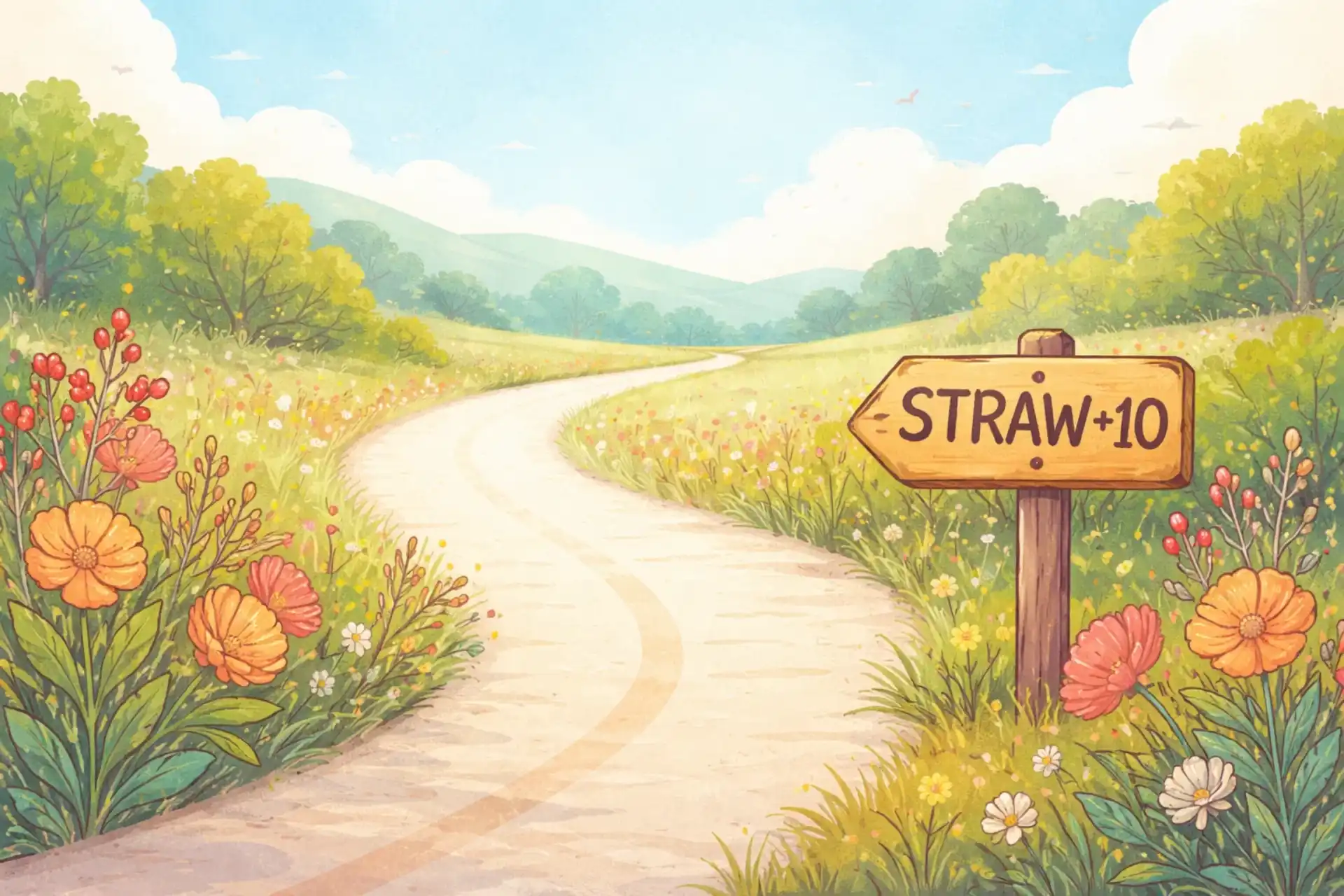
Darling, menopause can feel confusing not because you’re doing anything wrong, but because no one ever bothered to show you STRAW+10: The Menopause Roadmap.
Symptoms arrive out of order like guests at a badly organised dinner party. Advice contradicts itself faster than a politician before an election. And two women the same age can feel as though they’re living in entirely different bodies, on entirely different planets, having entirely different experiences.
Welcome to the chaos, gorgeous. Population: every woman over 40.
This is where STRAW+10 comes in, and trust me, it’s about to change everything.
Your Menopause Roadmap Has Arrived
STRAW+10 is an internationally recognised framework that explains how menopause actually unfolds over time. Not through guesswork, not through age-based assumptions, and definitely not through outdated advice from people who think menopause is “just hot flashes.”
Instead, it uses clear phases and stages to map the entire journey from your reproductive prime to your postmenopausal power years.
This page is your menopause roadmap. A place to zoom out, get your bearings, take a proper breath, and finally understand how everything fits together. Because once you can see the structure, the confusion starts to dissolve like ice in a martini glass.
Why Menopause Needs a Roadmap (And Why No One Gave You One)
Here’s the thing, ma chérie: menopause (or the ‘renewal years,’ as I like to call it — read this, and you’ll understand why) isn’t one moment. It’s not a light switch that flips on your 50th birthday while you’re blowing out candles.
It’s a transition that can stretch over many years, often beginning long before the word “menopause” ever enters the conversation. Yet most of us are handed information in fragments: a symptom here, a hormone there, a vague platitude about “this too shall pass” somewhere in the middle. Very little context. Even less support.
As a result, many women end up wandering through the fog wondering:
Is this normal?
Am I early… or late?
Why does my experience feel so different from hers?
And why didn’t anyone warn me it would be like THIS?
STRAW+10 helps answer those questions by focusing on timing and patterns, not just symptoms. Because once you understand the structure underneath the experience, confusion gives way to clarity.
Panic softens into perspective. And that persistent voice in your head asking “what’s wrong with me?” finally gets the answer it deserves: “Nothing, darling. Absolutely nothing.”
What Is STRAW+10? (In Actual English, Not Medical Jargon)
STRAW+10 stands for Staging Reproductive Aging Workshop + 10 years. Which, let’s be honest, sounds like a conference you’d skip in favor of the wine bar. But stay with me, because this framework is actually brilliant.
It was developed by international experts as a standardised way to describe the phases and stages of reproductive ageing in women. While it’s widely used in research and clinical settings (where they love their acronyms and their clipboards), it also works beautifully as a framework for understanding menopause in real life. Your life. The one you’re living right now.
Rather than relying on age alone, because your ovaries didn’t get the memo about averages, STRAW+10 looks at:
Menstrual cycle patterns (are they regular, irregular, or have they ghosted you entirely?)
The final menstrual period (FMP) (the main event, darling, when your ovaries officially retire)
Hormonal trends over time (the behind-the-scenes chaos you can’t see but definitely feel)
The result? A clearer picture of where you are in the transition, even when things feel about as predictable as British weather.
If you’d like to explore how STRAW+10 was developed and why it’s considered the global gold standard (spoiler: because it actually works), you can dive deeper into What Is STRAW+10? for the full background story.

The Three Phases of Your Menopause Journey
At its core, STRAW+10 divides reproductive ageing into three broad phases, each containing specific stages. Think of it as act one, act two, and act three of a play you didn’t audition for but are absolutely starring in.
The Reproductive Phase
This includes the years of regular cycles and peak fertility, gradually shifting toward subtle early changes that most women don’t even notice. Your ovaries are showing up to work with their lunchboxes packed, doing their thing, keeping everything relatively predictable. This is the calm before the storm, honey, enjoy it while it lasts!
The Menopausal Transition (Perimenopause)
Ah, perimenopause. The phase where most of the actual drama unfolds. This is where cycles become as irregular as a teenager’s sleep schedule, hormones fluctuate more dramatically than your mood after a glass of wine, and changes can feel wildly unpredictable.
Hot flashes make their grand entrance. Sleep becomes optional. And your body starts acting like it’s auditioning for a reality show called “What Fresh Hell Is This?”
This phase often lasts several years. Sometimes a delightful two, sometimes a brutal ten. And it’s the reason most women find themselves Googling “am I losing my mind or is this menopause?” at 2 a.m.
Postmenopause
This begins after your final menstrual period and reflects a new hormonal baseline. No longer transition, darling adjustment. Your hormones have found their new normal (or as close to normal as they’re going to get).
Symptoms usually settle down. And you enter what I like to call the “I survived that nonsense and now I’m unstoppable” phase.
Each phase is made up of stages that help explain when changes tend to happen, even though every woman’s experience remains beautifully, frustratingly, magnificently unique.
For a clear breakdown of each phase and stage, complete with timelines, hormonal changes, and what the hell is actually happening to your body, visit STRAW+10 Stages Explained.
Why STRAW+10 Focuses on Stages, Not Just Symptoms
Symptoms matter. Of course they do. Hot flashes, mood swings, night sweats, brain fog they’re real, they’re disruptive, and they deserve attention.
But here’s the thing: symptoms don’t exist in isolation. They’re not random. And they’re definitely not a sign that you’re falling apart.
STRAW+10 helps explain why:
Symptoms don’t follow a neat checklist (because your body isn’t a form to be filled out)
The same symptom can feel different year to year (thanks, fluctuating hormones!)
Two women can experience menopause in completely different ways (and both be totally normal)
By anchoring symptoms to stages, rather than age or assumptions or “well, my mother went through menopause at 52 so I probably will too,” STRAW+10 provides context. It reframes “What’s wrong with me?” into “Ah, this is where I am on the map.”
If symptoms are what brought you here, if you’re dealing with hot flashes that could melt steel or mood swings that rival any soap opera. You may find it reassuring to explore Perimenopause Symptoms by STRAW+10 Stages, where symptoms are explained through timing rather than alarm bells and panic.
How to Use This Roadmap (Without Obsessing Over Every Detail)
This isn’t something you follow step by step like a recipe for Sunday roast.
It’s something you refer back to. A touchstone. A “wait, let me check where I am” resource for those moments when your body throws you a curveball and you need to regain your bearings.
Use this roadmap to:
Understand where you might be in the transition (so you can stop feeling lost)
Ask clearer questions in healthcare appointments (because “I feel weird” isn’t cutting it)
Make sense of changes without self-blame (it’s not you, darling—it’s your hormones)
Remember that unpredictability doesn’t mean abnormal (chaos can still have a pattern)
You don’t need to memorise stages or labels. You don’t need to know your FSH levels off the top of your head. Even a general understanding can bring a surprising sense of calm. Because knowledge, ma chérie, is the antidote to panic.
Start Where It Feels Right (There’s No Wrong Door)
Everyone arrives here with a different question. A different symptom. A different level of confusion or curiosity or “I just need someone to explain this to me like I’m five.”
You might want to:
Understand the stages themselves → STRAW+10 Stages Explained
Make sense of perimenopause symptoms → Perimenopause Symptoms by STRAW+10 Stages
Learn how this framework was created → What Is STRAW+10?
There’s no right order. No required reading. No test at the end. The roadmap simply makes sure you’re never lost—and that wherever you are, you can see where you’ve been and where you’re heading.
A Final Word (Because You Deserve One)
Menopause isn’t chaos—even when it feels spectacularly, overwhelmingly, “why is this happening to me” chaotic.
There is a structure beneath the experience. A pattern underneath the madness. A roadmap through the fog.
And once you can see it? Everything shifts. You stop feeling as though you’re guessing your way through the dark. You stop wondering if you’re the only one experiencing things this way. You stop questioning whether you’re broken, behind, or imagining things.
Because you’re not.
You’re simply moving through a transition that finally, finally has a map. A framework. A way to make sense of it all.
This roadmap is here whenever you need perspective, to remind you that you’re exactly where you’re supposed to be, doing exactly what you’re supposed to be doing, and handling it all with more grace and grit than you probably give yourself credit for.
So take a breath, darling. You’ve got this. And now you’ve got the map to prove it.