
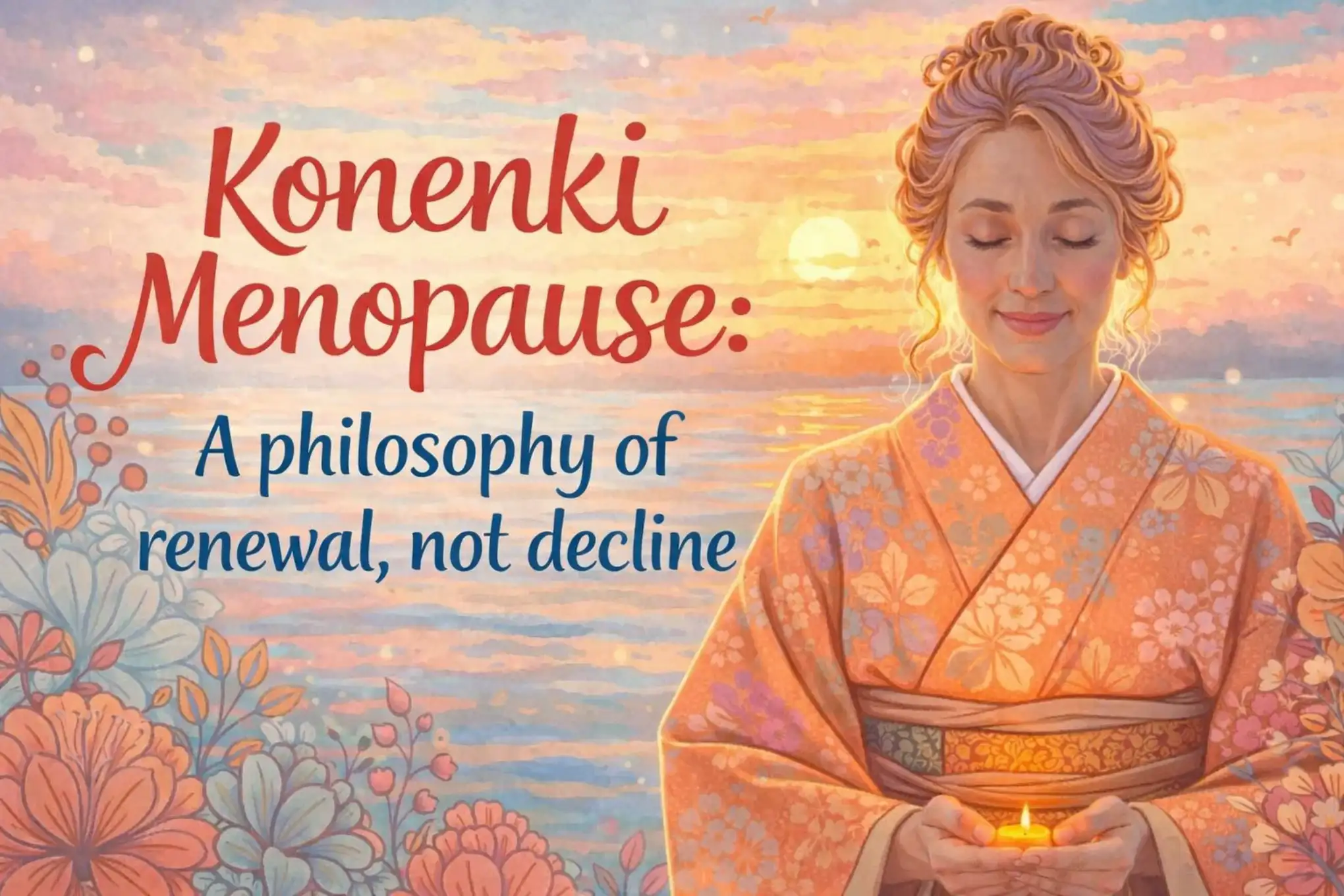
Konenki Menopause: Reclaiming What I Thought I’d Lost

A Japanese Perspective on Menopause, Identity, and Renewal
I remember the exact moment it hit me. Not my first hot flash, though that arrival was memorable enough to warrant its own Netflix special, but the moment I realized what menopause actually meant.
Twelve months without a period. Official menopause status unlocked. And my first thought? “Well, that’s it then. You’re done, sweetheart.”
Not done with life exactly, but done in that fundamental, biological, “the good part is over now” way that Western culture loves to whisper in women’s ears like the world’s worst fortune teller.
You know that feeling? Standing at what looks like a finish line when you thought you were still mid-race?
Facing a future that suddenly resembles nothing but decline, invisibility, and eventually just… waiting around for the inevitable? Absolutely delightful stuff. Really perks up a Tuesday.
But then, I literally stumbled across konenki menopause. I’d never heard of it before. It’s a Japanese perspective that reframes this entire transition not as an ending but as a beginning.
Your renewal years, darling. And once I understood what that actually meant, I got back something I didn’t realize menopause had stolen: my future.
Not just any future, but an exciting, vibrant, “pour the good wine because I’m just getting started” kind of future.
This is how one word—konenki—transformed everything and gave me back what I thought I’d lost forever.
What Is Konenki? (The Word That Changes Everything)
Let’s talk linguistics for a hot minute, because sometimes the right word arrives like a designer handbag on sale. Exactly what you needed at precisely the right moment.
Konenki (更年期) is the Japanese term for menopause, but here’s where it gets gorgeous: it translates to “renewal years.”
Not “the change” whispered like you’re discussing something illegal. Not “going through menopause” like you’re trudging through airport security in socks. Renewal years.
Your body updating its operating system, not shutting down the entire computer and listing it on eBay.
The kanji characters break down beautifully: 更 (kō) means “renew” or “update”, think iPhone getting sleeker, not your laptop retiring without notice. 年 (nen) means “year.” 期 (ki) means “period.” Together?
A term that positions menopause as a natural phase of renewal rather than a medical emergency requiring intervention and possibly therapy.
Compare that to Western terminology. “Menopause” comes from Greek: “men” (month) and “pausis” (cessation). Cessation. Full stop. Game over, thanks for playing. The etymology alone sounds like someone’s giving up and going home early.
And don’t even get me started on the medical terminology. “Ovarian failure.” Yes, that’s actually what doctors call it when your ovaries stop releasing eggs, because apparently someone thought the word “failure” would really boost morale during this transition.
Here’s why this matters, honey: language shapes reality. When your culture gives you “renewal years,” you approach hot flashes differently than when doctors inform you of “ovarian failure” and “hormonal deficiency.”
One framework opens a door to possibility; the other suggests your body just declared bankruptcy and is liquidating assets.
The Japanese chose language acknowledging change while framing it as evolution, not decline. Your body isn’t betraying you, it’s updating to version 2.0.
And after decades of periods, cramps, and surprise pregnancy scares? Version 2.0 sounds rather fabulous, doesn’t it?
What I Thought I’d Lost
Here’s what nobody warns you about when menopause arrives: it’s not just the hot flashes or irregular periods that mess with your head.
It’s the sudden, crushing realization that you’ve apparently reached your expiration date as a woman.
At least, that’s what decades of Western cultural messaging had quietly installed in my brain like malware I didn’t know I’d downloaded.
I thought I’d lost my relevance, darling. My value. That indefinable thing that made me visible in rooms and conversations.
Because somewhere along the way, I’d absorbed this toxic idea that a woman’s worth was tied to her fertility, her youth, her proximity to childbearing years.
And now that was over. Done. Finished like last season’s hemline, suddenly irrelevant and slightly embarrassing.
I thought I’d lost my future excitement. The sense that good things were still coming, that adventures awaited, that the best chapters weren’t all behind me gathering dust.
Instead, the future looked like a long, slow decline into invisibility punctuated by doctor’s appointments and discussions about calcium supplements.
Thrilling stuff, really. Should’ve sold tickets.
I thought I’d lost my attractiveness, my femininity, my right to feel sexy or desired or even remotely interesting. Because menopause meant dried up, right?
That’s the phrase that gets thrown around like it’s clinical fact rather than the most depressing euphemism ever invented. Dried up.
As if women are basically houseplants that stop blooming and should probably just accept being moved to a back corner somewhere.
I didn’t realize how much this narrative had stolen from me until konenki gave me a different perspective and I got it all back.
Sometimes you don’t know you’re living in a prison until someone hands you the key and says, “Actually, you can just leave.”
10 Perimenopause Surprises
Welcome to perimenopause, darling. The biological surprise party where all the guests show up unannounced, nobody brought wine, and the host (that's you) is standing there thinking, "I'm 42. This wasn't supposed to start yet.
This guide tells you what no one else will tell you. Not even your doctor.
How I Discovered Konenki Menopause
I stumbled onto konenki the way most good things arrive, completely by accident while looking for something else entirely.
I was researching for one of my blog posts either The Question You’re Not Asking or Menopause Hormones: The Royal Ballet (two great posts by the way, you should read them 😉).
Because nothing says “fun Saturday night” like falling down internet research rabbit holes, and there it was: this Japanese concept that treated menopause as renewal years rather than the biological apocalypse Western culture had promised me.
At first, I was skeptical. Honestly, my immediate reaction was something like, “Oh, how lovely and Zen, but surely this is just pretty packaging on the same miserable experience.”
Because I’d been so thoroughly marinated in the Western doom-and-gloom narrative that anything positive about menopause felt like someone trying to sell me beachfront property in the Sahara. Suspicious at best.
But then I started digging deeper into what konenki actually meant. Not just the translation, but the philosophy behind it. The idea that this transition wasn’t an ending but an actual beginning.
That renewal wasn’t just a pretty word but a legitimate framework for viewing this entire stage of life. That maybe, just maybe, the story I’d been told about menopause being the start of irrelevance was complete nonsense invented by a culture terrified of aging women.
The moment it truly clicked for me was reading about how Japanese women discuss menopause. Not with the hushed, apologetic tones I’d been using, but matter-of-factly.
Casually. Like mentioning you’re updating your phone or redecorating your living room. A thing that happens. A transition you move through. Not a tragedy requiring sympathy cards and wine-fueled commiseration sessions (though wine is always welcome, let’s be clear).
I realized I’d been grieving something that didn’t need to be a loss. I’d been mourning the end of something without considering that endings create space for beginnings.
And konenki, this beautiful, empowering concept that had been sitting in Japanese culture for centuries, was offering me a completely different way to experience this transition. A way that didn’t require me to shrink, apologize, or accept invisibility as my inevitable fate.
So I decided to try it. To adopt this perspective and see what happened when I stopped viewing menopause as “the change” (ominous, threatening) and started viewing it as my renewal years (exciting, promising). And that, darling, changed absolutely everything.
How Kōnenki Changed the Way I See Menopause
The shift didn’t happen overnight. I’m not selling you a miracle transformation involving crystals and affirmations, honey.
But once I started viewing menopause through the konenki lens, something fundamental changed in how I experienced this entire stage of my life.
I stopped apologizing. That was the first thing. I’d been unconsciously apologizing for menopause, for hot flashes interrupting conversations, for brain fog making me lose my train of thought, for simply existing as a woman past her fertile years.
As if my body doing exactly what it’s designed to do at this age was somehow inconvenient to everyone around me. Konenki said, “Stop that nonsense immediately.”
This is renewal, not malfunction. No apologies required for updating your operating system.
My language around aging shifted dramatically. Instead of saying “I’m getting older” with that slight grimace we’re all taught to wear, I started saying “I’m in my renewal years” with actual enthusiasm.
The difference? One sounds like resignation; the other sounds like anticipation. Same wrinkles, same grey hairs (okay, expertly colored, but still), completely different energy.
Turns out how you describe your experience actually shapes how you experience it. Revolutionary stuff, truly.
I stopped viewing my future as a countdown to irrelevance and started viewing it as… well, my future. With possibilities. With adventures I haven’t had yet. With chapters I haven’t written.
The konenki perspective didn’t magically erase my hot flashes or give me back my 25-year-old metabolism (sadly), but it did give me back my sense that good things are still coming.
That I’m not winding down, I’m gearing up for whatever comes next in this renewal phase.
Here’s what really changed, darling: I stopped letting other people’s discomfort with my menopause dictate my experience of it.
When someone made a “joke” about hot flashes or aging, I didn’t laugh along anymore.
When media portrayed menopausal women as dried-up, sexless, irrelevant creatures, I stopped absorbing that as truth.
Konenki gave me permission to reject the entire Western narrative and write my own instead.
Turns out that permission was all I needed.
How I Use Konenki Menopause Language Now
I use “renewal years” constantly now, and I absolutely love watching people’s faces when I do.
There’s usually a moment of confusion,”renewal years?”, followed by curiosity, then something that looks suspiciously like relief.
As if I just gave them permission to reframe their own experience.
When friends complain about “going through menopause” (said with maximum dread), I gently redirect: “You mean you’re in your renewal years?”
It sounds like semantic hairsplitting, but honey, the difference is profound.
One phrase positions you as a passive victim; the other positions you as actively transitioning into something new. Same hot flashes, wildly different mindset.
I’ve started introducing konenki to other women like I’m sharing the world’s best-kept secret, which, let’s be honest, I am.
“Have you heard about the Japanese concept of konenki?” usually opens the most fascinating conversations.
Some women grab onto it immediately, grateful for a framework that doesn’t position them as failing or declining.
Others are skeptical at first (fair enough, I was too), but curious enough to explore what it might mean to view this transition as renewal rather than loss.
The responses I get are telling. Women light up when they hear “renewal years.” You can literally see the shift happen.
Shoulders relax, faces soften, something that looked like dread transforms into curiosity.
Because the Western narrative is so heavy, so relentlessly negative, that offering an alternative feels like opening windows in a stuffy room. Fresh air, darling. That’s what konenki provides.
Even with strangers, I use this language now. When someone asks about my age or stage of life, I say “I’m in my renewal years” with zero apology and complete confidence.
The reactions range from intrigued questions to visible envy from women still trapped in the “ovarian failure” narrative.
And honestly? Spreading this perspective feels like the best kind of rebellion, rejecting the story we’ve been sold and choosing a better one instead.
Konenki Menopause & STRAW+10: Meaning Meets Structure
Now, embracing konenki doesn’t mean wandering through your renewal years without a map, and this is where STRAW+10 becomes absolutely essential.
If konenki provides the empowering philosophy, STRAW+10 provides the detailed roadmap showing exactly where you are and what’s typical for your menopause transition specific stage.
STRAW+10 is a staging system that breaks down your reproductive journey, from fertile years through postmenopause, into distinct, well-defined stages. Think of it as GPS for your renewal years.
Instead of vaguely wondering “is this normal?” or “when does this end?” you can pinpoint your exact stage and understand what’s expected there. Knowledge is power, sweetheart, especially when your hormones are throwing a party you weren’t invited to plan.
Here’s why pairing konenki with STRAW+10 is absolute genius: konenki gives you the beautiful philosopy that this is renewal, not decline. STRAW+10 gives you the science, the biological roadmap, the practical knowledge of where you are hormonally and what’s happening in your body at each specific stage of the menopausal transition.
You’re not just optimistically declaring “I’m renewing!” while having no idea what your body is actually doing, you’re renewing with information, understanding exactly which stage of the menopausal transition you’re in, and realistic expectations about what comes next.
Philosophy and science, working together. Eastern wisdom meets Western biology. The perfect partnership for your renewal years.
When you know you’re in early transition (Stage -2), those irregular cycles aren’t alarming, they’re exactly what Stage -2 looks like. That hot flash during your presentation? Late menopause transition, Stage -1 behavior, perfectly on schedule.
You’re not spiraling into WebMD-fueled anxiety wondering if something’s terribly wrong. You’re recognizing that your body is exactly where it should be in the renewal process, doing precisely what Stage -2 bodies do.
Twelve months without a period and officially in Stage +1, first year postmenopoause? Congratulations 🥂, darling, you’ve graduated from transition into postmenopause, and your tampon budget just became your wine budget. (Priorities, honey.)
The konenki mindset transforms how you interpret your STRAW+10 stage. Instead of thinking “Stage -2 means I’m failing,” you think “Stage -2 means I’m actively renewing. My body is recalibrating for what’s next.” Same biology, completely different emotional experience.
One feels like decline; the other feels like transformation with a roadmap.
Wondering which stage you’re in? Our Perimenopause Quiz will pinpoint your position on the STRAW+10 continuum faster than you can say “is someone messing with the thermostat again?”
The beauty of combining konenki with STRAW+10? You get both inspiration and information. Philosophy and practicality. The empowering reframe that makes you feel powerful, plus the detailed guide that keeps you from feeling lost. Your renewal years deserve both, darling.
That’s not asking too much, that’s asking for exactly what you deserve.
And you deserve the world darling, you really do. 💋✨🔥



Leave a Comment